01
The transcript comes in.
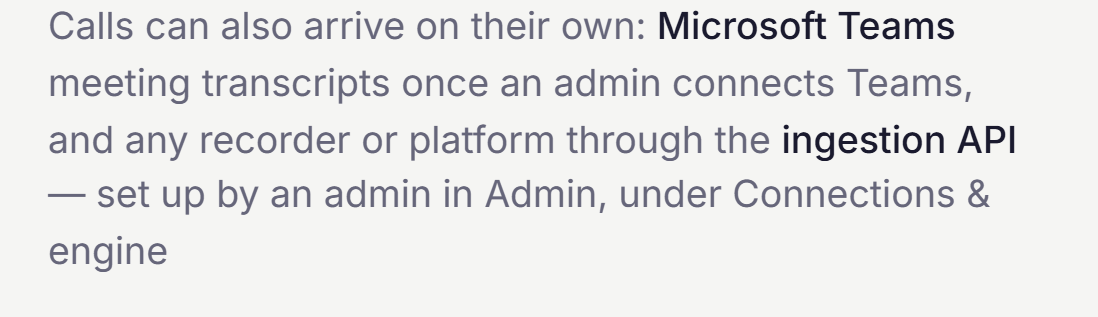
After the meeting, with no bot in it: Teams calls arrive on their own, and any other call comes in by API, upload or paste.
Your CRM knows what was entered. Talqo knows what the buyer said.
One Teams transcript, real or anonymised.
Drafted from the call. Approved by your team. Traced to the buyer.
The product film · sample deals, not a customer’s
Still typing every call into the CRM by hand?
Forty-odd calls a month, from memory. The details get lost on the way in.
Chasing the reps for the real number every week?
And guessing at a commit nobody can stand behind.
Ever shown the board a number the quarter never delivered?
Typed in three weeks earlier. Never checked against the call.
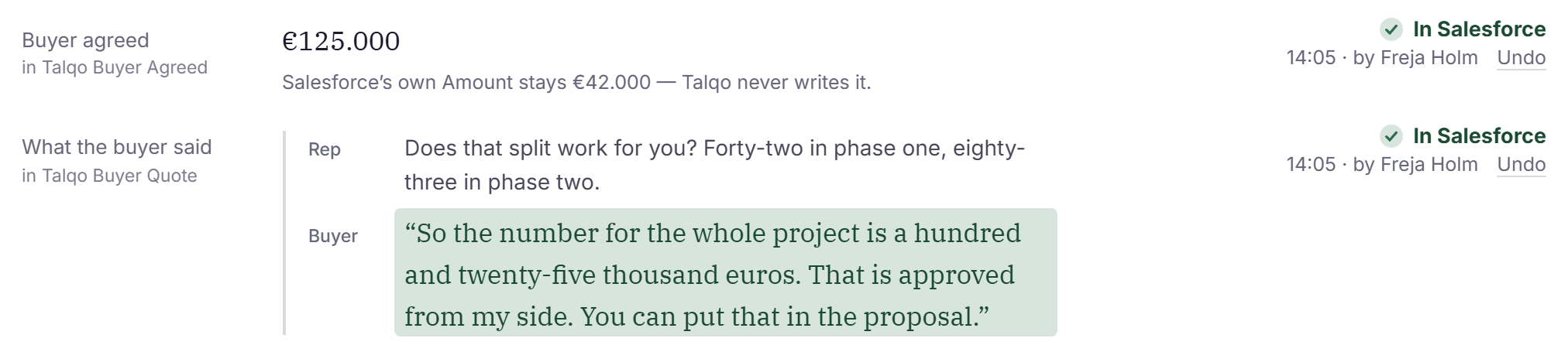
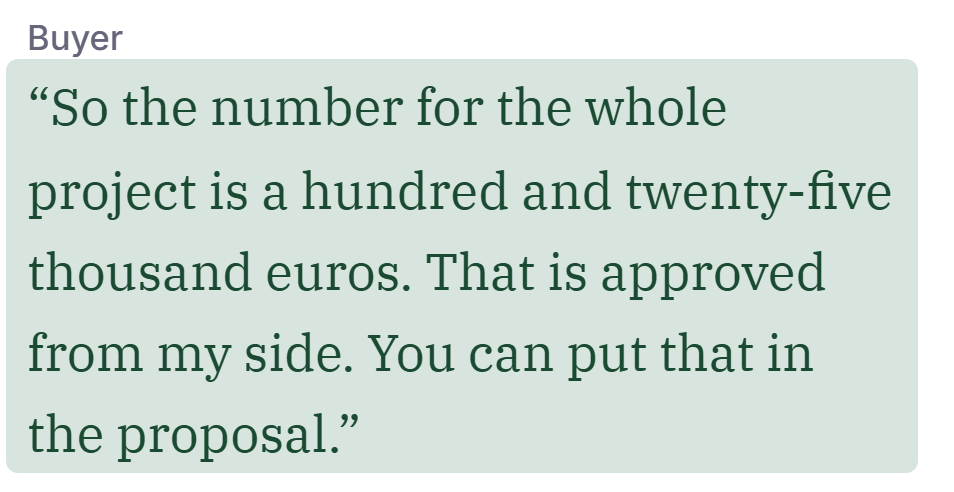
“So the number for the whole project is a hundred and twenty-five thousand euros.”
After the meeting, with no bot in it: Teams calls arrive on their own, and any other call comes in by API, upload or paste.
Where the buyer names a figure, a date or an agreement, Talqo keeps their exact words and shows them under the field.
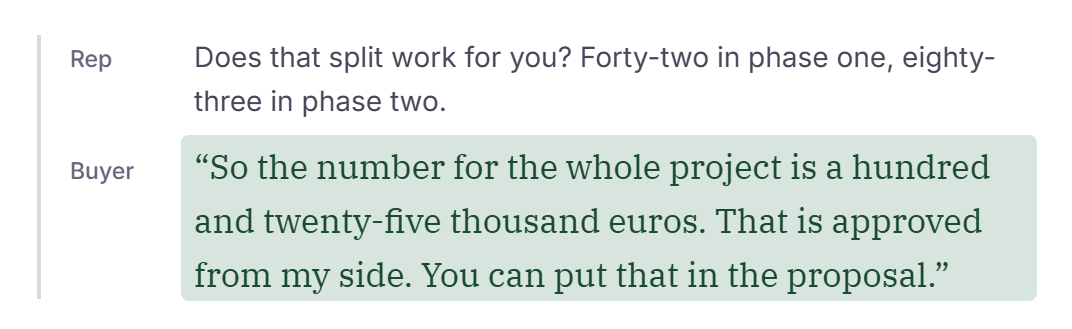
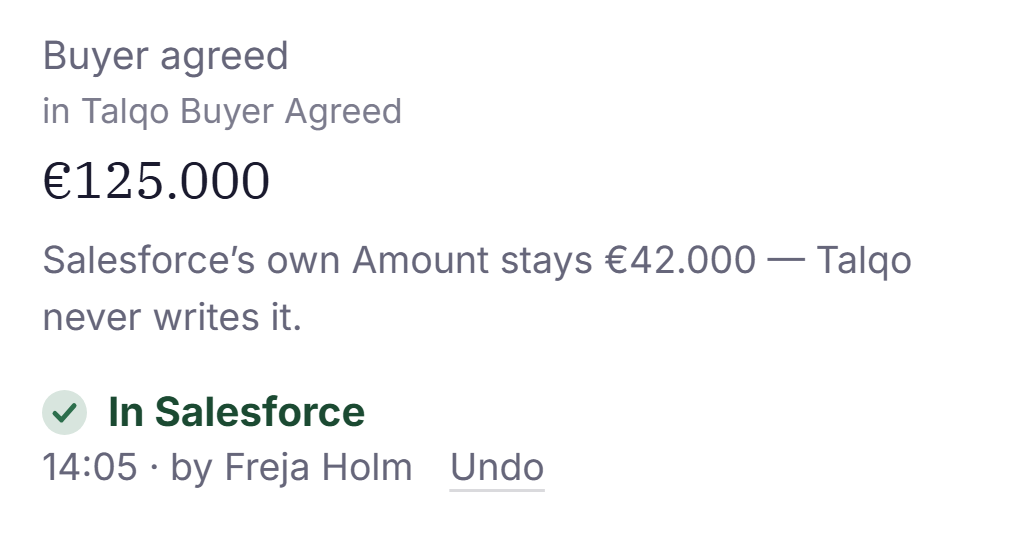
Nothing is written until your rep, or their manager, approves it, and the receipt names who. On Salesforce the buyer’s figure goes beside your Amount, never over it.
Writes to Salesforce · HubSpot · any CRM by signed webhook · Microsoft Teams calls arrive on their own
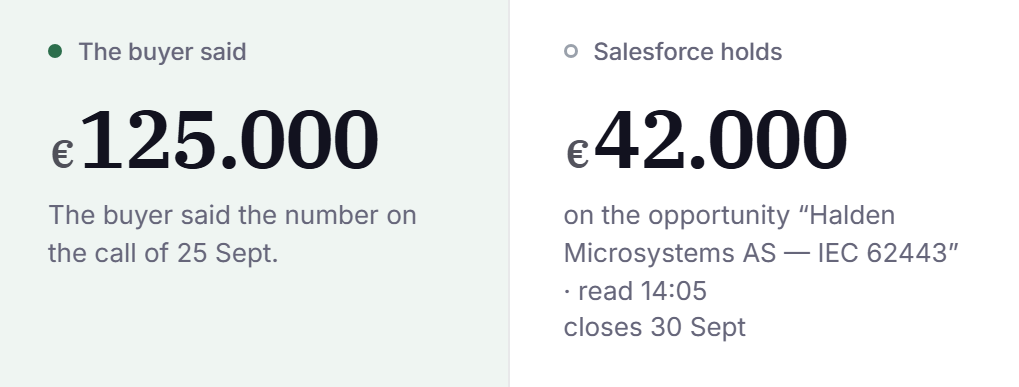
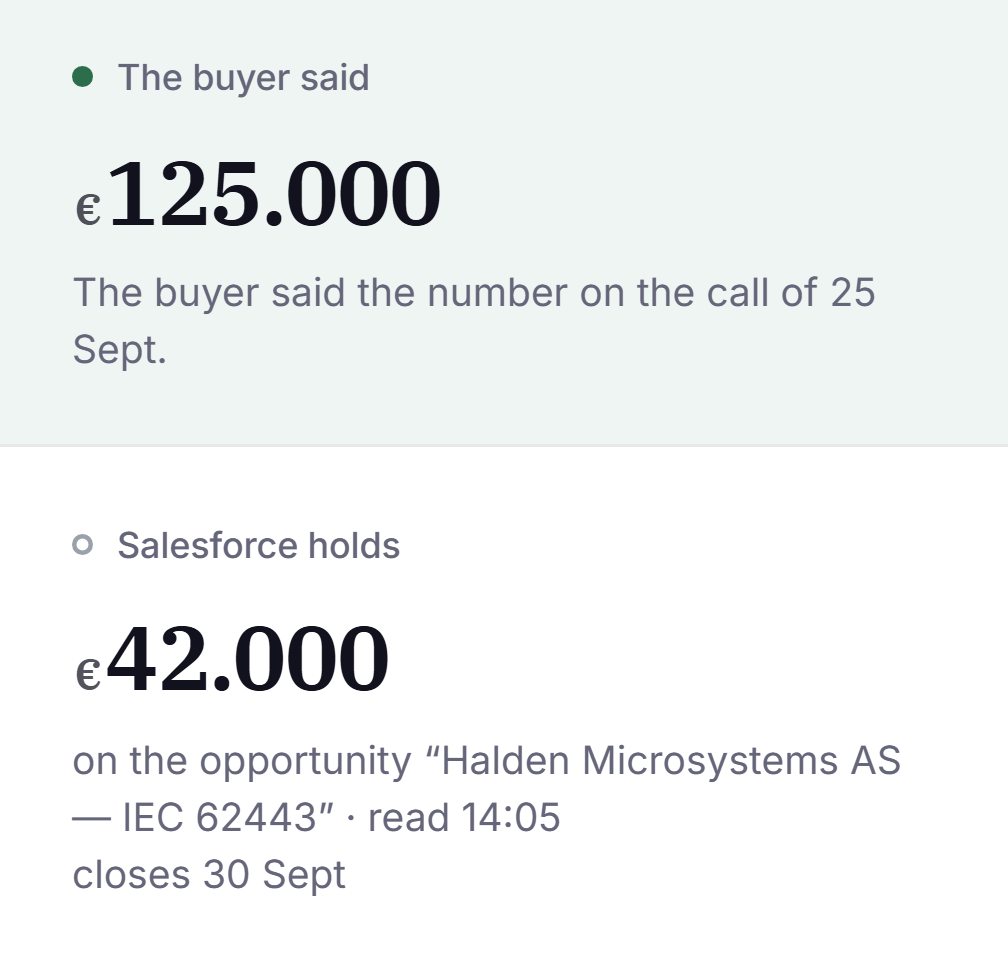
Open a figure and it lists the deals behind it, each at the buyer’s number, with the sentence and the call it came from. If we cannot show you the sentence, we do not say the buyer said it.
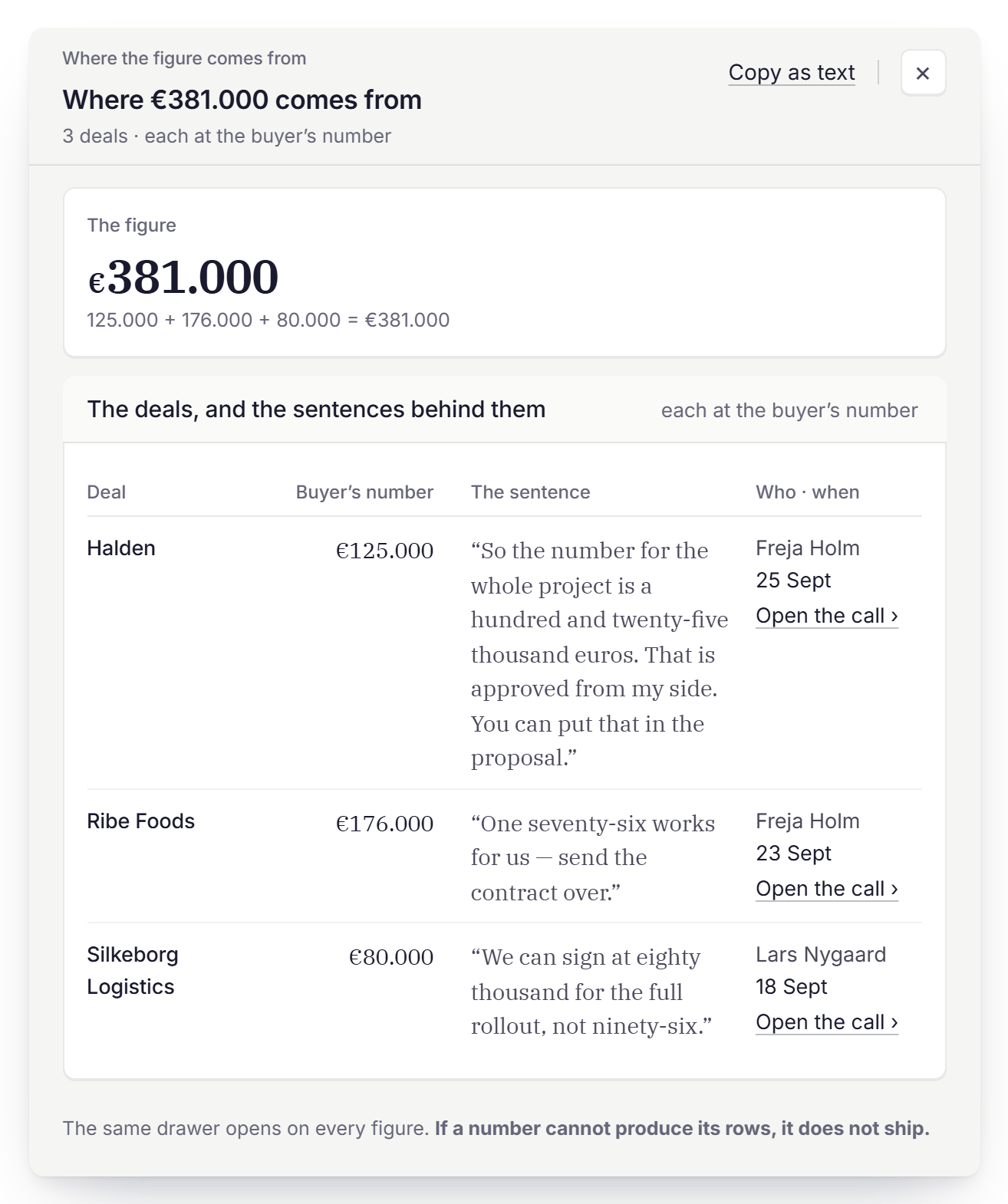
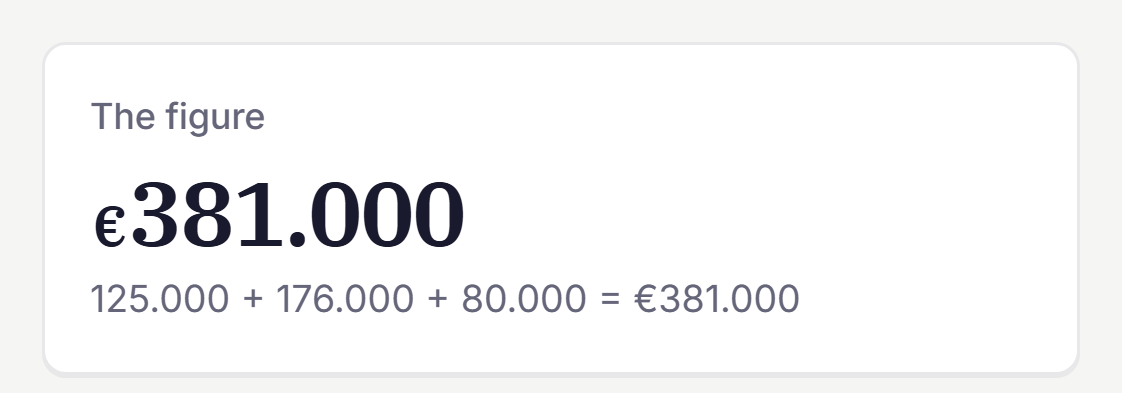
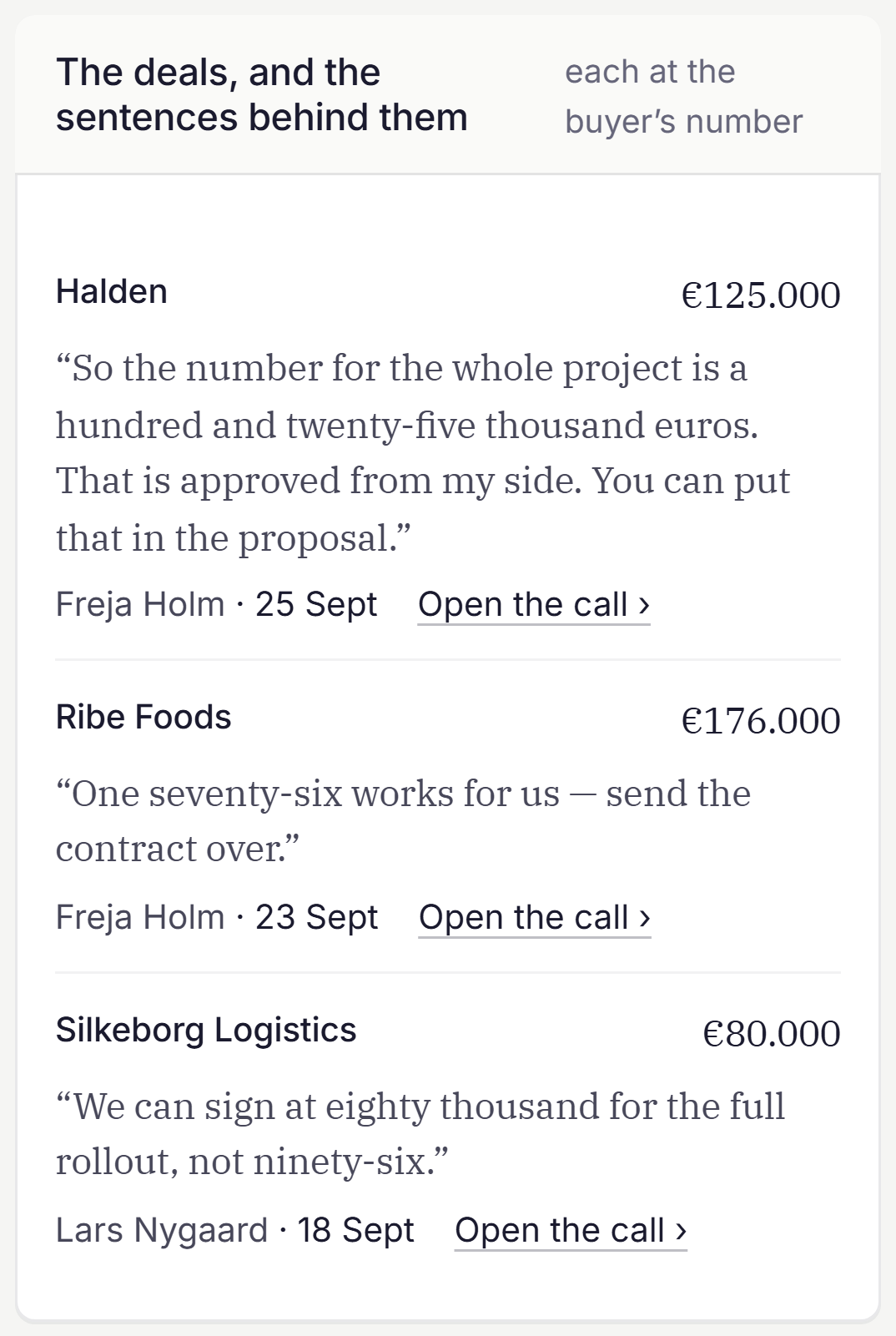
Captured from the running product, · sample deals and analysis, not a customer’s
Paste two minutes of a sales conversation. No IT approval needed to find out if it works. Anonymised is fine, here and in the call you send us.
What you paste is analysed and thrown away: never stored, never used for training, never sent to a CRM. Privacy.
Hosted in Frankfurt; analysis can run on your own Azure OpenAI in the EU.
Analysed, then discarded. Talqo keeps the structured read.
AES-256-GCM at rest, never returned by any API.
Not ours yet. Render and Anthropic hold SOC 2 Type II; Azure is SOC 2 audited.
What we don’t have yet: our own SOC 2 or ISO 27001, a third-party penetration test, single sign-on, SCIM, a second login factor, or a tenant-wide audit log.
Prove it on your own calls before anyone signs for more.
I spent about ten years selling B2B. Most of that time I sat in pipeline reviews built on optimism.
I never once saw anyone check that number against what the customer had actually said. Talqo does the checking, and you will be talking to the person who built it.
No. Talqo records nothing and no bot joins the meeting. It reads the Microsoft Teams transcript after the meeting ends, only for the people you map and only for meetings they organised. Zoom, Meet or a phone call: upload the transcript, paste it, or send it through the transcript API. Until you connect Teams or the API, nothing is captured at all.
No. There is no autonomous write, and no setting that turns one on. Your rep, or their manager, approves each field, and the receipt names who. We refuse rather than guess: if a deal stage isn’t mapped, or a record isn’t linked, the write stops and tells you why, with the proposal still waiting. On Salesforce and HubSpot any write can be undone for seven days, as long as nobody has changed the field since; a webhook delivery cannot be undone.
Salesforce natively, where Talqo writes only its own fields: your Stage, Amount and Close Date are never written. HubSpot natively: the deal’s own stage, amount and close date, and a note. Anything else through a signed webhook: ten minutes in Zapier or Power Automate puts it into Pipedrive, Zoho, monday, a spreadsheet, or something you built yourself. BANT, MEDDIC, MEDDPICC and SPIN are built in. Run something else? We set Talqo up around your methodology.
Then Talqo says so. The item reads Missing, with the question to ask next, and no figure is invented to fill it. Talqo would rather show you a gap than fill it.
Application and database in the EU (Frankfurt). Transcripts are analysed, then discarded; only the structured analysis is kept, in your account, deletable on request. By default Anthropic analyses the calls, under the EU’s Standard Contractual Clauses. Want the analysis in the EU too? It can run on your company’s own Azure OpenAI resource, in the EU region you choose; we connect it with you. Security has the detail.
Chad reads every result and replies within one working day: the deal facts, the coaching, and the things it refused to score.